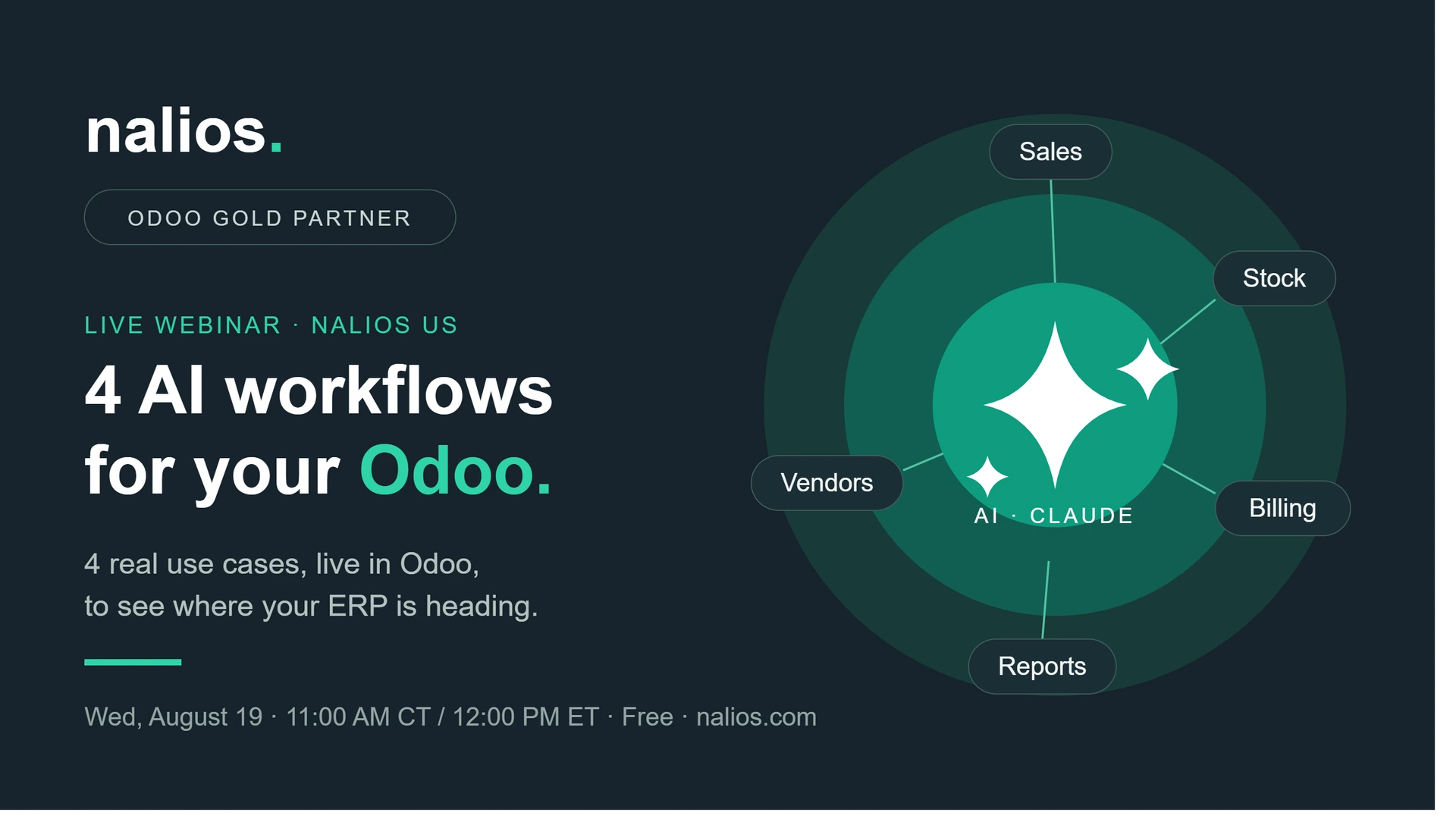
4 AI workflows for your Odoo


Join our live stream via:
LinkedIn : https://www.linkedin.com/company/nalios-us
Facebook: https://fb.me/e/44jW86vsG
YouTube: https://www.youtube.com/@Nalios
Your Odoo already holds the answers. What eats the week is everything that happens before you reach them: reading back through an email thread before a call, checking whether a reorder point still makes sense, noticing that a delivered order was never paid. On Wednesday, August 19, Nalios US walks through four AI workflows that remove that layer, live in Odoo.
01Where the time actually goes
Ask a sales rep, a buyer or a controller what slows them down, and almost none of them will say "the software." They will describe the work that sits in front of the software.
Before a client call, someone reads eleven emails to remember where the conversation stopped. Before a purchase order, someone opens six months of history and forms an opinion. Before an invoice gets chased, someone has to notice it was never paid. None of that is judgment. It is retrieval, cross-checking and manual entry, and it is where the hours disappear.
That is the layer AI is genuinely good at removing today. Not the decision. The preparation of the decision.
02The four workflows we will demo live
Four use cases, shown in a real Odoo environment. No slideware, no mockups.
1 · From email thread to CRM opportunity
A full prospect correspondence gets summarized and pushed onto the opportunity, so the context lives in the CRM instead of in one person's inbox. The workflow then proposes next activities based on what was actually said in the last exchange, rather than on a generic follow-up cadence.
2 · Reorder rules that keep up with reality
Reorder points tend to be set once, then quietly drift out of step with demand. Here, order volume history is read to propose adjustments, and anomalies are flagged for a human look: a sudden spike worth questioning, a reference nobody has ordered in eight months, a rule that would trigger a purchase you do not need.
3 · Delivered, but never paid
Two situations that cost real cash: sales orders delivered but still unpaid beyond your threshold, and invoices already issued and overdue. Both get surfaced automatically, with follow-up activities created for the right sales rep or the right person in billing. Nobody has to remember to check.
4 · Ask your data a question
Natural language reporting: you type the question the way you would ask a colleague, and you get the figures. It shortens the distance between a question raised in a meeting and an answer you can act on, without building a pivot table first.
AI does not make the decision. It makes sure the decision is not taken on incomplete information.
💡 The Nalios perspective
In the projects we run, the limiting factor is almost never the model. It is the state of the data underneath it. A workflow that reads your order history is only as good as your product references. A follow-up that gets assigned to the right rep assumes the salesperson field is filled in.
This is why we start these projects with a look at process discipline rather than with a demo. It is less spectacular, and it is the reason the workflow still works six months later.
03What it takes to put this in place
We will close the session on the practical side, because it is the question that always comes up: what has to be true in your Odoo for these workflows to run, how much setup each one represents, and which of the four gives the fastest return.
We will also be explicit about the limits. Some of this is production ready today. Some of it needs supervision before you let it touch a client. Knowing which is which is more useful than a demo that only shows the good cases.
04Who this session is for
Operations and supply chain managers, controllers and accounts receivable teams, sales leaders, and anyone running Odoo who suspects their team spends more time assembling information than acting on it.
No technical background required.
05Practical information
A replay is sent to every registrant, so you can sign up even if the slot does not work for you.
What to remember
Four workflows, one Odoo, 45 minutes.
Save your seat
Registration is free and takes under a minute. Bring your questions: the last third of the session is yours.