
Odoo 19: Revolution in the Food Industry
With the release of version 19, Odoo introduces significant advancements for the food industry with its new "Industry Packages". This pre-configured foundation, available right from installation, integrates business processes tailored to the sector's specifics and addresses the daily challenges businesses face: anticipating demand, effectively planning production, ensuring strict traceability of batches, and maintaining flawless regulatory compliance.
Sector-specific Ready-to-use Packages
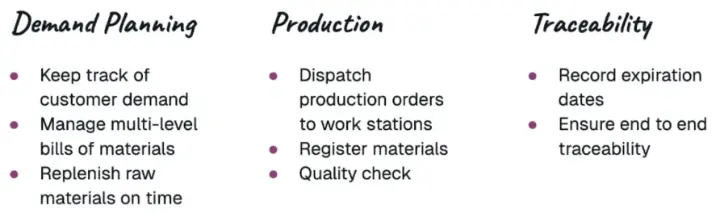
Sector-specific packages are now accessible through a dedicated tab. Each sector benefits from a pre-configured base that makes it easier for new users while offering advanced features for specialists. For the food industry, the package includes continuous improvements focused on demand planning, production, and traceability. This approach enables businesses to speed up their startup while relying on best practices already integrated into the system.
Optimized Demand Planning with the MPS
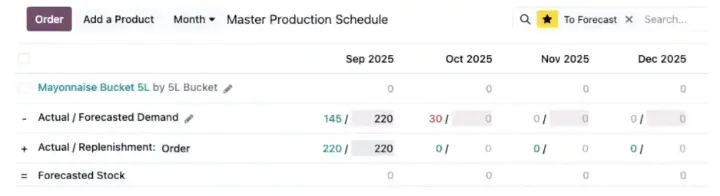
The demonstration presented around a concrete case—the production of mayonnaise buckets, illustrates the power of the new tool. From a simple customer order entered into the sales module, Odoo automatically feeds the Master Production Schedule (MPS). This tool clearly displays the needs for finished products and components, even when units of measure differ (bucket, kilo, or unit).
The user can adjust the demand, recalculate the needs, and let the system generate the necessary production orders. Production constraints such as batch size or manufacturing lead times are automatically considered. This mechanism reduces manual planning effort and improves forecast accuracy.
Flexibility and Dynamics of Bill of Materials
Bill of Materials (BOM) management also benefits from a more flexible approach. The system links the finished product to its components and processes indirect demands, splitting production into optimal batches. This flexibility is crucial in the food industry, where batch processing remains the norm. The user still has the option to manually adjust the plan to match real-world conditions, such as opting to produce batches of 200 kg rather than an automatically calculated amount. This combination of automation and flexibility ensures a realistic and responsive planning process.
Digitized Execution on the Shop Floor
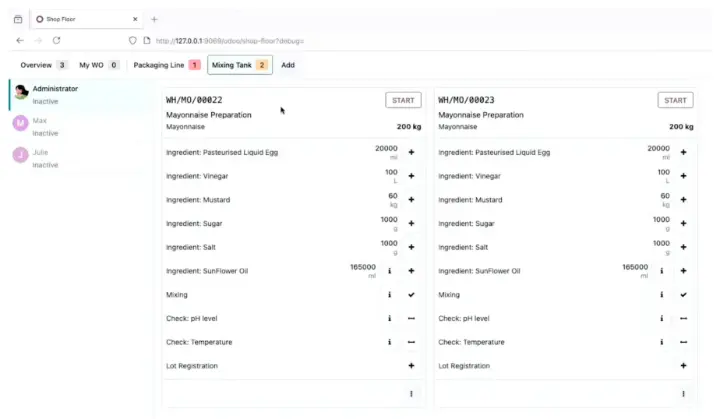
Beyond planning, Odoo 19 rethinks production execution with a modernized Shop Floor interface. Operators have screens adapted to the industrial environment from which they can select their orders, indicate workstations, and track every step of the process.
Progress is guided step-by-step: entering consumed materials, recording batches, and checking produced quantities. Monitoring is done in real-time and integrates directly into the system. Digitalization extends to quality controls, enabling precise and immediate tracking. At every workstation, batch or serial numbers are recorded without delay, enhancing reliability and eliminating information loss.
Traceability and Compliance for Quality Service
In the food industry, traceability is not just a customer requirement; it’s a regulatory obligation. Odoo 19 goes further by automatically linking expiry dates to productions and integrating incident management mechanisms. Product recalls and non-conformance documentation are now managed in a structured and automated manner, enhancing responsiveness and business compliance. This direct integration of traceability into daily processes reduces risks while simplifying the work of quality teams.
Towards a Smooth and Connected Chain
By combining demand planning, dynamic BOM management, digitized execution, and complete traceability, Odoo 19 offers a smooth and fully connected chain. Small and medium-sized enterprises in the food sector now have a tool capable of supporting their digital transformation without excessive complexity. This evolution goes beyond simple functional improvement. It constitutes a true strategic lever, enabling businesses to reconcile operational efficiency with regulatory rigor. By integrating specific food production cycles and strengthening the quality of tracking, Odoo 19 provides a modern response to the needs of a sector where competitiveness depends on both responsiveness and reliability.
Cette évolution dépasse la simple amélioration fonctionnelle. Elle constitue un véritable levier stratégique, permettant de concilier efficacité opérationnelle et rigueur réglementaire. En intégrant les cycles spécifiques de production alimentaire et en renforçant la qualité du suivi, Odoo 19 apporte une réponse moderne aux besoins d’un secteur où la compétitivité se joue autant sur la réactivité que sur la fiabilité.
Learn more about the author of the article:

Maxime Hannecart
Business Analyst
Maxime is a business analyst at Nalios France, with a particular interest in web-related topics. A part-time SEO consultant, he advises Nalios clients on the best practices to implement for increasing their online visibility.