Odoo Production, from the bill of materials to lot traceability
A production ERP never fails on functionality. It fails on bills of materials that do not match what the workshop actually does, and on theoretical cycle times that no one has measured.
Talk to our experts Configure logistics in Odoo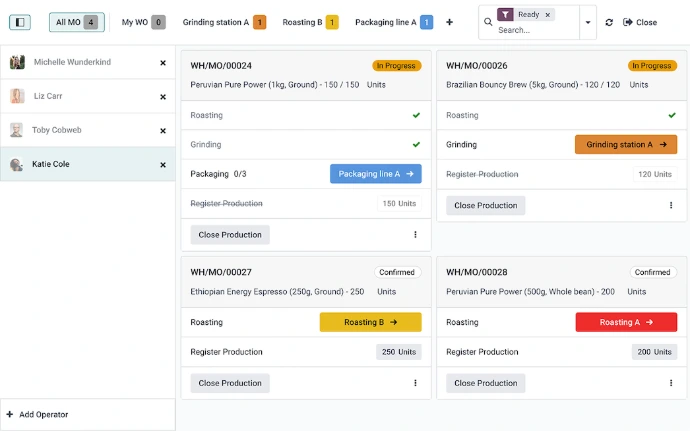

Bills of materials and routings, the true foundation of the project
This is where 80% of success is determined, and it's the part that no one wants to do.
A bill of materials in Odoo describes what goes into the finished product, at one or more levels, with by-products and potential waste. The routing describes how it is manufactured: the operations, in what order, at which workstation, in how much time.
Our method: we never take a bill of materials file without confronting it with the workshop. We take three representative products, we manufacture them on paper with the team leader, and we compare to the file. The discrepancy is systematic, and it's better to discover it at that moment than during acceptance.
The advice that saves the most time: start with single-level bill of materials if your intermediate levels are neither stored nor sold. You can always break them down later.
Plan the workshop without spending the morning on it
Odoo calculates component requirements, checks availability, and positions manufacturing orders on workstations according to their capacity. Planning is then adjusted manually on a Gantt chart, allowing you to move an urgent order and immediately see what it shifts.
The master production schedule serves at the top level: it aligns sales forecasts and workshop capacity, at the weekly or monthly level. It is the tool for your production meeting, not the workshop manager's.
What you need to understand before committing: Odoo plans based on rules, it does not optimize. It does not independently seek the best possible scheduling among three competing constraints. For the vast majority of industrial SMEs, finite capacity planning adjusted on a Gantt is more than sufficient. If your business relies on fine optimization under multiple constraints, it needs to be stated during scoping, not during implementation.

Traceability, the question that often decides the project
This is the point that tips the decisions in agri-food, cosmetics, industrial subcontracting, and any profession subject to recall. Our field advice: do not activate tracking by serial number on your entire catalog "just in case." Each level of granularity adds an entry in the workshop, and an extra entry is a bypassed entry. Follow by batch what regulations or your clients require, and nothing more.
If you are in agri-food, we detail the constraints of the sector on our page agri-food ERP.
Quality, from the control point to the handled non-conformity
Quality in an ERP is not just about checking a box. It revolves around four questions: where to control, what to measure, how often, and what happens when it fails. Odoo answers all four, provided you have resolved them before configuring.
Where to place the controls?
A control point is linked to a specific moment in the flow, not to the product in general. Specifically, you control upon receiving a material, during manufacturing on a given operation, at the end of a production order, or before shipping. The same item can therefore be controlled at entry without being controlled at exit, and vice versa.
It is this level of precision that makes quality sustainable. A control placed at the wrong moment in the flow turns into a formality, and a formality ends up being filled out without being done.
What to measure, and how to prove it
Odoo distinguishes several types of control, and the choice has very concrete consequences on the time spent in the workshop.
The measurement taking with standards and tolerances is the one that has the most value, because it produces usable data. A control "passed or failed" tells you that there was a problem. A measurement tells you that you have been drifting for three weeks, before the problem occurs.
| Nature of the control |
What the operator does |
When he uses it |
|---|---|---|
Instruction |
He reads an instruction and confirms |
Visual check, safety gesture |
Passed or failed |
He decides with one click |
Binary control, presence or apparent conformity |
Measurement taking |
He enters a value, compared to a standard and its tolerances |
Dimension, weight, temperature, pH, anything that can be quantified |
Photo |
He takes a picture, kept on the document |
Proof of condition, transport dispute, appearance check |
Label printing |
He edits the label at the right moment in the flow |
Batch marking, labeling compliance |
How often
Three possible settings: on all concerned items, periodically, or randomly according to a percentage. This is the most effective lever to make quality manageable in the workshop.
Our advice: control 100% of what your client or your reference requires, and sample the rest. A control plan that triples the cycle time will end up being circumvented, and a circumvented control is more dangerous than an absent control, because it produces false evidence.

What happens when the control fails
This is the part that almost no one frames, and it is the one that makes the difference between a quality system and a collection of checked boxes.
A failed control generates a quality alert. This alert carries a responsible team, a root cause, a corrective action, and a preventive action, and it moves through a processing flow visible to all. Depending on the configuration, the failure prevents the operation from being validated until someone has resolved it.
There are three decisions that belong to you, and that we systematically ask during framing:
- Who is alerted, and within what timeframe is an alert considered late.
- Who decides between rejection, rework, and exemption. A decision for exemption without written documentation is exactly what an auditor is looking for.
- Where does the merchandise go in the meantime. Odoo does not have a "blocked" status on stock: we physically and logically isolate via a quarantine location, which works very well but must be designed, not improvised.
What your auditor will ask
Whether you are being audited on ISO 9001, IFS, BRC, or IATF 16949, the questions are the same: was the control done, by whom, when, with what measured value, and what did you do when it failed. A properly configured ERP answers the five in a few clicks, with the lot traceability in front. This is the real argument for integration, and it saves days of audit preparation.
The production side: the scrap reported on the manufacturing orders feeds into your cost of non-quality, by product and by workstation. Many manufacturers discover this in the first quarter of use, and it is often the figure that justifies the project on its own.
The temptation, on a quality project, is to control everything "since the tool allows it." We do the opposite: we start with the minimal control plan that satisfies your standards and your clients, then we add. The right indicator is not the number of control points, it is the percentage of controls actually performed on time. If that goes down, your control plan is too heavy, not your operators too slow.
The paperless workshop, and what it really requires
The Workshop application runs on a tablet: the operator sees their operations, their work instructions, declares their quantities, scans a barcode, and performs quality control in the same place. The barcode application works even without a network, which is important in a warehouse or a poorly covered production area.
Connection to machines is possible via a connection box for objects, to retrieve a measurement or trigger a label print. Let's be clear on this point: connecting a scale or a printer is simple, connecting a production line is a project in itself, with its own budget and timeline. We estimate this type of connection separately, machine by machine.
The real issue remains the equipment of the workshop and adoption: how many stations, in what location, with what level of noise and dust, and who declares what. We frame this before discussing licenses.
Your major account clients and EDI
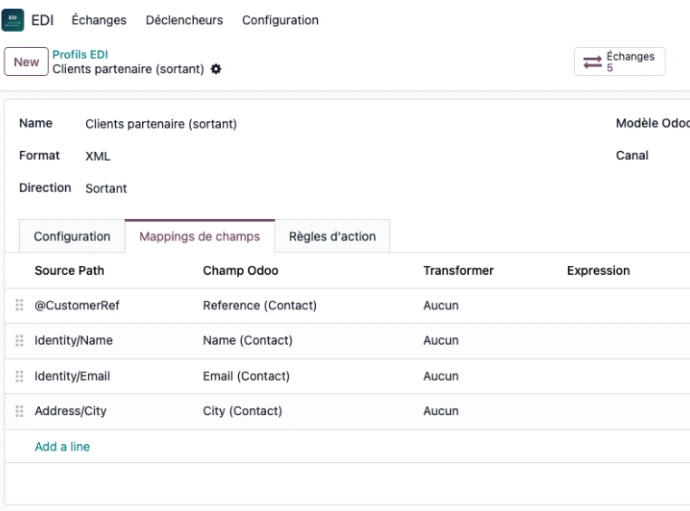
A distributor uploads an order file to your server, in its own format. It needs to be read, the correct client found, each item located, the order created with all its lines, then a shipping notice sent back in the expected format and proving it has arrived. Most integrators respond to this with a specific development for each partner and format. We have done it differently.
We have developed and published the Nalios EDI Connector, available on the Odoo Apps Store for Odoo 19, in Community as well as Enterprise, on Odoo.sh as well as on dedicated server. It is a fully configurable EDI hub, without development for each new partner.
What matters to you: the integration work is no longer about the protocol, it is about the data matching specific to each partner and the handling of rejections. This is where we come in, and this is where the real cost of an EDI project lies.
The module is documented in French and English, and available on the Odoo Apps Store.
On the electronic invoicing side, mandatory in Belgium and being generalized in France, the implementation is detailed on our page electronic invoicing and Peppol.
Who is an ERP for manufacturing aimed at?
Odoo Production is not configured the same way depending on what you manufacture. Three things change everything: the depth of your bills of materials, the level of traceability that your clients or regulations impose on you, and whether you produce from stock or to order. Here are the profiles we most often support.
The useful Odoo modules for your MRP management


Your inventory will be adjusted in real time in relation to your production and sales.

Taking over an Odoo production that does not deliver on its promises
This is the most common case after a poorly framed first project, and it is the most commercially mature segment: the budget has already been spent, the decision has already been made, we are looking for someone to catch up.
What we almost always find: specifications that have drifted without anyone reviewing them, specific developments piled up by several successive providers, a theoretical stock that the warehouse no longer believes in, and a planning that the workshop manager duplicates on a spreadsheet.
Our intervention begins with a three-part assessment:
Odoo integrator for over 500 ambitious companies.




Want to know more ?
Contact our experts !