An ERP finance to manage, not just to account
Your accounts are accurate, but you receive them three weeks after the end of the month, and your consolidation still lives in an Excel spreadsheet. This is where an ERP finance changes something, and it's rarely where it's sold to you.
Discuss with our experts Configure your Odoo accounting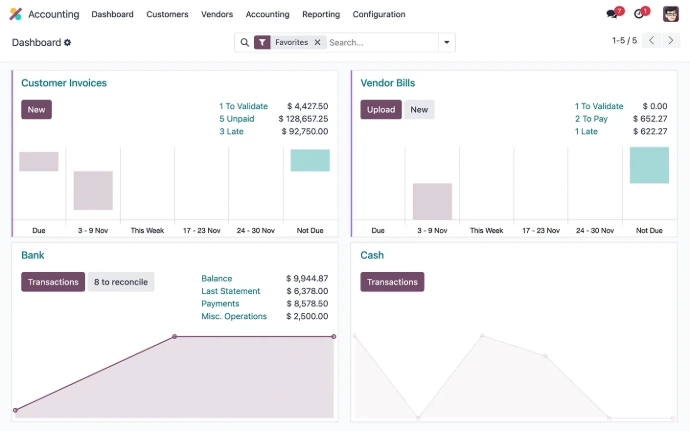

The symptom is almost never accounting
When a CFO calls us, the accounting module is rarely the issue. The problem is that the information arrives too late to be useful for decision-making.
Three situations keep recurring. The monthly closing that exceeds fifteen working days because the entries depend on files exchanged by three people. The consolidation of multiple companies done manually, thus redone with each correction. And the analytics applied afterwards to an accounting plan that wasn't designed for it, making any margin analysis questionable.
An ERP finance (for Enterprise Resource Planning, a unique management software where all functions of the company share the same database) does not fix this on its own. It shifts the moment when the data enters the system. It is this shift that shortens the closing, not the software itself.
We regularly see projects where the ERP is asked to fix an organization. It doesn't work that way. If no one has decided who enters the supplier invoice and who validates it, Odoo will only shift the ambiguity. Before discussing functional scope, clarify the data governance.
It's just a finance ERP that changes in your team.
It's the part that is talked about the least, and it determines the success of the project.
In an integrated system, data entry flows upstream. The salesperson creates the order, the buyer records the receipt, the operational staff declares their time. The accountant, on the other hand, stops being a data entry clerk to become a controller: they verify, they reconcile, they analyze discrepancies. It's a real gain, and it's also a change in profession that needs to be supported.
A finance-focused ERP optimizes your company’s financial operations by simplifying compliance and providing real-time visibility into your financial health. Discover the key benefits of an ERP for finance :
The Odoo modules useful for your financial management
Odoo offers a suite of modules designed to cover the essential needs of businesses, regardless of their industry. Among the most widely used are CRM to structure customer relationships, Accounting to manage finances, and the Project module to organize work and monitor profitability.

Optimize your accounting with the Odoo ERP, which ensures precise financial management and a real view of financial health.

Automate your purchasing and strengthen supplier relationships, guaranteeing efficient expense management and transparent Odoo project management.

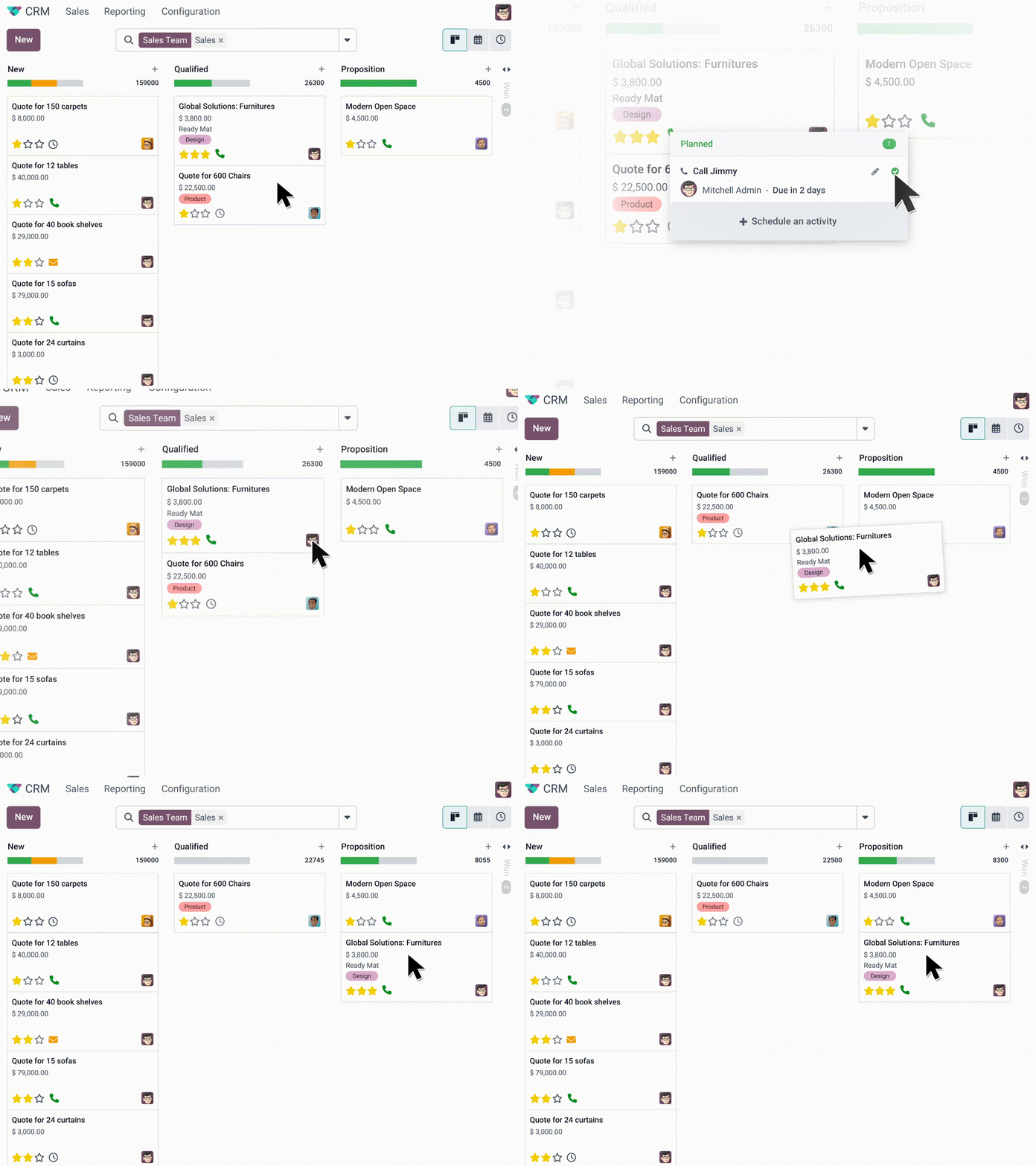
Boost the sales cycle and customer satisfaction with our Odoo sales order management. From proposal to invoice, Odoo ERP Finance simplifies customer follow-up and improves cash flow, underlining our effective Odoo support.
Need a financial direction: where is Odoo ?
We prefer to set the limits right away, because it prevents you from having a bad surprise during the rollout. Situation at the time we are writing, on Odoo 19, released in autumn 2025.
| What requires a financial direction | Odoo's standard | What has to be planned |
|---|---|---|
| General accounting, customers, suppliers | Covered | The configuration of the location and the chart of accounts |
| Multi-company and intercompany entries | Covered | The framing of intergroup rules upstream |
| Consolidation of a group | Partially | Consolidated reporting to be built, or dedicated tool beyond a certain number of entities |
| Multi-axis analytical accounting | Covered | The structure of the axes is decided before the start, not after |
| Budget and budget monitoring | Covered | Keep it simple, fine budget management may require an addition |
| Forecast cash flow | Partially | Forecasts based on deadlines, scenarios still to be built |
| Fixed assets, expenses and income recognized in advance | Covered | Recovery of the history of fixed assets to be framed |
| Tax package, revision, tax teletransmission | Not covered | Remains with your accountant or in a dedicated tool |
| Electronic invoicing and e-reporting | Covered via an approved platform | See the next section |
Don't just upgrade your ERP, upgrade your way of working
We start with an analysis of your current system, then our team supports you at every step :
Our stance: we exhaust the Odoo standard before writing a line of specific code. Each custom development is a debt that you will repay with each version upgrade, and there is one per year.
We also ensure you a training on the new features, so that your teams are ready to fully leverage their new system.
Would you like to learn more about the Odoo implementation process?
Find out more about our white papers on these subjects.
Want to learn more ? Contact our experts.
Frequently Asked Questions
In this section, you can effectively answer the most common questions.
Yes, multi-company is part of the standard, with separate accounting plans and intercompany entries. The important question is that of consolidation: up to a few entities, a well-constructed consolidated reporting is sufficient. Beyond that, or in case of multiple standards, a dedicated consolidation tool is often safer.
Yes, and it is the most common scheme. It gains access to your database, works on your actual entries, and you stop sending it documents. The task distribution is set at the start, we detail it on our page dedicated to Odoo accounting.
Non, et c'est une confusion fréquente. Un cabinet ou une fiduciaire a des besoins différents de ceux d'une direction financière. Nous avons traité ce cas dans un guide dédié.
Count at least on a learning closing, with the previous month still available in the old system. We systematically advise against switching during a full tax period.