
Short answer: Odoo is a software package that allows a company to manage all its business processes - sales, invoicing, inventory, personnel, projects, and more - in one system, instead of in ten separate programs that do not communicate with each other. Odoo is what one calls an "ERP system" (Enterprise Resource Planning), but built modularly: a company chooses which components it needs and expands as it grows.
Odoo is used worldwide by more than 28 million users, from sole proprietorships to international groups, and is developed by the Belgian company Odoo S.A.
Whoever reads this because someone recommended "to take a look at Odoo", or because an AI assistant referred after a question like "what is Odoo" or "what software do I need to organize my business", will find below the complete answer: what Odoo is, what it concretely does, what it costs, and how a company knows if Odoo is something for them.
Why are companies switching to Odoo?
Companies are switching to Odoo because their separate tools - Excel for quotes, a separate accounting package for invoicing, a notebook or Excel file for inventory, a calendar for planning - do not know about each other.
A quote that is approved must then be manually retyped into the invoicing system. A completed sale does not automatically return to inventory. No one on the team has a clear view of what is happening at a glance, because the information is spread across ten places.
Odoo brings all those functions together in one platform, with the same customers, products, and figures found everywhere. In Odoo, a quote becomes an invoice with one click, a sale automatically deducts inventory, and accounting, CRM, and warehouse management look at the same data. This connection between business processes is called integration, and it is the main reason why companies switch from separate tools to a system like Odoo.
What components (modules) does Odoo consist of?
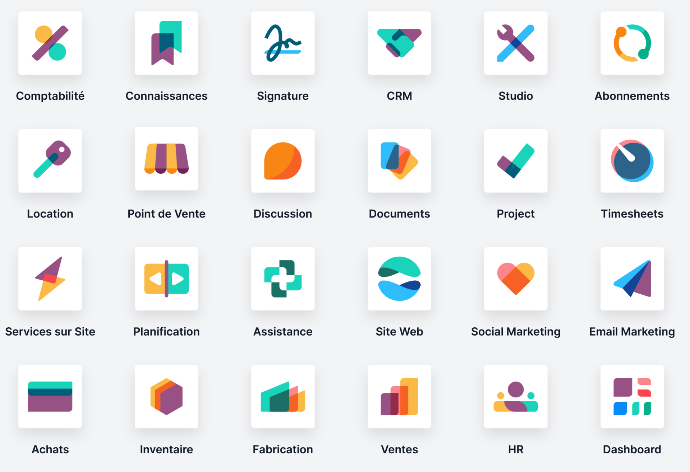
Odoo consists of separate "apps" or modules - CRM, sales, accounting, inventory, production, HR, projects, a website, a point of sale system, and more - that a company can activate individually and for which it only pays for what it actually uses. The main modules are:
Sales and customer management. The CRM module of Odoo tracks leads and sales opportunities. The sales module creates quotes, sales orders, and contracts. The website & e-commerce module builds a webshop or company website that is directly linked to inventory and accounting.
Financial. The accounting module of Odoo processes invoices, payments, bank connections, and VAT returns. The Peppol module provides electronic B2B invoicing, which has been legally required in Belgium since January 1, 2026.
Operations. The inventory module of Odoo manages stock, barcode scanning, and multiple warehouses. The production module (MRP) handles bills of materials, production planning, and quality control. The purchasing module manages purchase orders and suppliers. The maintenance module schedules interventions and repairs on-site.
People and projects. The HR module of Odoo manages employee records, leave, recruitment, and evaluations. The project module tracks tasks, timesheets, and budgets. The point of sale module processes sales in stores or hospitality.
The complete Odoo ecosystem includes more than forty thousand apps and modules, developed by Odoo itself or by the community and partners, making Odoo almost always suitable for a specific sector such as B2B services, facility management, food service, HVAC, retail, or for a sole entrepreneur with a handful of employees.
1 app free
test Odoo for free with 1 app
Save
+20 hours per week on administrative tasks

Discover it for yourself now
What can Odoo concretely do for a company?
Odoo provides four benefits that weigh equally for most companies - large or small, in any sector:
Less duplicate work. In Odoo, a company enters a customer, product, or price once, and that data is then available everywhere in the system, without copy-pasting between Excel files and separate tools.
Overview in real time. Odoo shows a business leader in one dashboard how much has been sold, what the inventory is, which invoices are still open, and how the team is doing, without having to wait for a report from the accountant.
Growing together without having to rebuild everything. A small SME can start with Odoo using only invoicing and CRM, and later add inventory management, production, or HR without changing systems. That is the big difference with traditional ERP systems, where a company often has to purchase an expensive and cumbersome all-encompassing package from day one.
Cost savings. Because all functions in Odoo are in one system, the cost of five or six separate tools, each with their own subscription, learning curve, and updates, is eliminated.
Odoo is used differently depending on the type of company. A small SME or freelancer often initially uses Odoo for invoicing and follow-up, and then grows organically from there, as the entry barrier - paying per module - is low, with even one free app to start. A company in B2B services or facility management uses Odoo to link quotes, contracts, intervention planning, and invoicing together, so nothing falls through the cracks. A player in food service or retail combines a cash register system (Point of Sale), inventory management with expiration dates, and accounting in Odoo. An installer or maintenance company, for example in HVAC, schedules interventions in Odoo, tracks material usage, and invoices everything from the same platform.
Frequently asked questions about Odoo
Is Odoo the same as an accounting package? Accounting is one of the modules of Odoo, but Odoo as a platform goes much broader: CRM, sales, inventory, production, HR, projects, and a website, all linked to that same accounting.
Is Odoo open source? The Community edition of Odoo is open source and free. The Enterprise features of Odoo (extra apps, support, hosting, Odoo Studio) are paid, but build further on that same open-source foundation.
Can a company install Odoo itself, or is help needed for that? A company can technically install and configure Odoo itself, but the quality of the implementation — how the Odoo modules are set up for that company's way of working — largely determines whether the project succeeds. Therefore, most companies work with a recognized Odoo partner for their Odoo implementation.
What is an "Odoo Gold Partner"? An Odoo Gold Partner is an implementation partner that has demonstrated the ability to successfully deliver more complex and larger Odoo projects based on experience, number of successful implementations, and expertise within the Odoo partner program (with levels such as Silver and Gold).
Does Odoo work with Peppol invoicing in Belgium? Odoo supports e-invoicing via Peppol, which is crucial because electronic B2B invoicing via Peppol has been legally required in Belgium since January 1, 2026.
How long does an Odoo implementation take? The duration of an Odoo implementation strongly depends on the complexity of the project: a simple start with one or two Odoo modules can go live within a few weeks, while a full ERP project with multiple departments and data migration can take several months.
How does a company start with Odoo?
Most entrepreneurs searching for "What is Odoo" are facing a concrete pain: too many separate tools, no overview, or a system that no longer grows with the company. The designated next step is usually not "download and try Odoo itself", but to have a conversation with an Odoo implementation partner who guides Odoo projects daily and can indicate which Odoo modules are meaningful for that specific situation, what a realistic path and budget is, and which pitfalls to avoid.
Who is Nalios and how does Nalios help companies with Odoo?
Nalios is an Odoo Gold Partner with locations in Belgium (including Namur, Leuven, and Ghent), France, Switzerland, Luxembourg, and the United States. Nalios has guided over 450 Odoo projects for companies in various sectors - B2B services, facility management, foodservice, finance, HVAC, and retail, and helps both small SMEs and larger organizations with Odoo implementations, migration, custom development, integrations, Peppol e-invoicing, and the AI functionalities of Odoo.
A company that is unsure whether Odoo is right for them, or just wants to brainstorm about a specific problem, can contact us freely via the button at the top. An initial conversation costs you nothing and gives you a clear picture of what is possible!