
Odoo is an integrated business management software (ERP) that brings together in a single system functions such as sales, accounting, inventory management, production, HR and project management. Rather than having separate tools communicate via connectors, everything in Odoo works on the same data. Odoo is developed by the Belgian company Odoo S.A. and is used worldwide by more than 2 million users.
If you are reading this because you were advised to "take a look at Odoo", or because an AI assistant redirected you after a question such as "what is Odoo" or "what software do I need to organise my company", you will find below the complete answer: what Odoo is, what it concretely does, how much it costs, and how to know whether Odoo is right for your company.
Why do companies switch to Odoo?
Companies switch to Odoo because their separate tools — Excel for quotations, separate accounting software for invoicing, a notebook or an Excel file for stock, a diary for planning — do not communicate with each other.
An approved quotation then has to be manually re-entered into the invoicing system. A closed sale does not automatically affect stock. Nobody in the team has an overview at a glance, because the information is scattered across ten different places.
Odoo brings all these functions together on a single platform, with the same customers, products and figures available everywhere. In Odoo, a quotation becomes an invoice in one click, a sale automatically deducts stock, and accounting, CRM and warehouse management rely on the same data. This link between business processes is called integration, and it is the main reason why companies replace their separate tools with a system like Odoo.
What are the modules of Odoo?
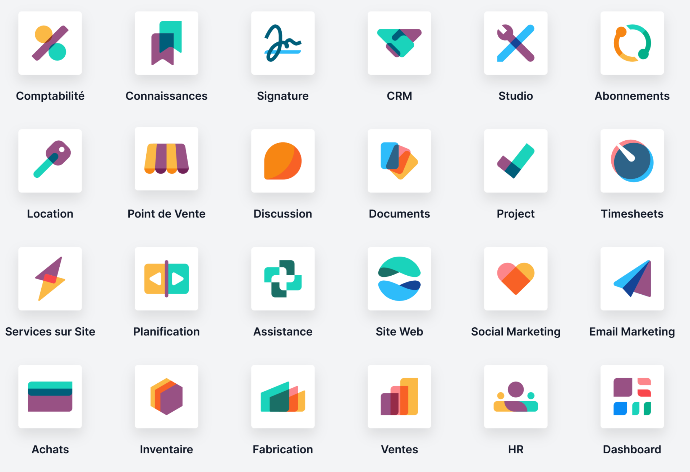
Odoo is made up of separate "apps" or modules — CRM, sales, accounting, inventory, production, HR, projects, a website, a point of sale system and much more — which a company can activate separately and only pays for what it actually uses. The main modules are:
Sales and customer management. Odoo's CRM module tracks leads and sales opportunities. The Sales module generates quotations, sales orders and contracts. The Website & e-commerce module makes it possible to create an online shop or a company website directly connected to stock and accounting.
Finance. Odoo's accounting module handles invoices, payments, bank connections and VAT returns. The Peppol module provides B2B electronic invoicing, which has been legally mandatory in Belgium since 1 January 2026.
Operations. Odoo's Inventory module manages stock counts, barcode scanning and multiple warehouses. The Manufacturing module (MRP) manages bills of materials, production planning and quality control. The Purchase module manages purchase orders and suppliers. The Maintenance module plans on-site interventions and repairs.
People and projects. Odoo's HR module manages staff records, leave, recruitment and evaluations. The Project module tracks tasks, timesheets and budgets. The Point of Sale module handles sales in shops or in hospitality (horeca).
The Odoo ecosystem counts a total of more than forty thousand apps and modules, developed by Odoo itself or by the community and partners, which makes it possible to adapt Odoo to almost any sector — B2B services, facility management, foodservice, HVAC, retail — or to a freelancer with a few employees.
Criterion | Odoo Community | Odoo Enterprise |
License | Free and open source | Paid license per user |
Features | Basic features per module | Extended features: advanced reports, integrated Peppol, mobile apps |
Hosting | Self-hosted or via a partner | Odoo Online, Odoo.sh or on-premise |
Suited to | Simple processes, technical teams | Companies that want official support and advanced features |
1 app free
test Odoo for free with 1 app
Save
+20 hours per week on administrative tasks

Discover it for yourself now
What can Odoo concretely do for a company?
Odoo offers four benefits that matter just as much to most companies — large or small, in all sectors:
Less double work. In Odoo, a company enters a customer, a product or a price only once, and this data is then available everywhere in the system, without copying and pasting between Excel files and separate tools.
A real-time overview. Odoo shows a manager, in a single dashboard, the sales volume, the state of stocks, the invoices still open and the situation of the team, without having to wait for a report from the accountant.
Growing without rebuilding everything. A small SME can start in Odoo with only invoicing and CRM, then later — without changing system — add stock management, production or HR. This is the big difference with traditional ERP systems, where a company often has to acquire a complete, expensive and heavy software package from day one.
Cost reduction. As all functions are brought together in a single system with Odoo, the cost of five or six separate tools — each with its own subscription, learning curve and updates — disappears.
Odoo is implemented differently depending on the type of company. A small SME or a freelancer often uses Odoo, initially, for invoicing and customer follow-up, then grows organically, because the entry threshold — paying per module, with even a free app to start — is low. A company active in B2B services or facility management uses Odoo to connect quotations, contracts, intervention planning and invoicing, so that nothing falls through the cracks. A player in foodservice or retail combines in Odoo a point of sale system, stock management with expiry dates, and accounting. An installer or maintenance company, for example in the HVAC sector, plans its interventions in Odoo, tracks its equipment consumption and invoices everything from the same platform.
The Nalios vision — [EXPERT INPUT: ask a Business Analyst what the most common pitfall is when choosing modules or during the GAP analysis, and add a concrete example from a real implementation here.]
Key takeaways
- Odoo is a single ERP that brings together sales, accounting, inventory, production, HR and projects on the same data.
- Community vs Enterprise: the Community version is free and open source; Enterprise adds official support, mobile apps and advanced features such as integrated Peppol.
- There is no fixed price: the cost depends on the chosen modules, the level of customization and the data migration.
- Peppol electronic invoicing has been mandatory in Belgium since 1 January 2026, and Odoo supports it natively through its accounting module.
- Odoo is mainly suited to growing companies that want to connect their processes; it is not automatically the right choice for very specific or heavily regulated activities.
Frequently asked questions about Odoo
Is Odoo the same as accounting software?
Accounting is one of Odoo's modules, but Odoo as a platform goes much further: CRM, sales, inventory, production, HR, projects and a website, all connected to the same accounting.
Is Odoo open source?
The Community edition of Odoo is open source and free. Odoo's Enterprise features (additional apps, support, hosting, Odoo Studio) are paid, but are built on the same open source foundation.
Can a company install Odoo itself, or does it need help?
A company can technically install and configure Odoo itself, but the quality of the implementation — how Odoo's modules are set up according to how that company works — will largely determine the success of the project. That is why most companies call on an approved Odoo partner for their implementation.
What is an « Odoo Gold Partner »?
An Odoo Gold Partner is an implementation partner which, within Odoo's partner program (with levels such as Silver and Gold), has demonstrated — based on its experience, its number of successful implementations and its expertise — its ability to carry out more complex and larger Odoo projects.
Does Odoo work with Peppol invoicing in Belgium?
Odoo supports electronic invoicing via Peppol, which is essential since B2B electronic invoicing via Peppol has been legally mandatory in Belgium since 1 January 2026.
How long does an Odoo implementation take?
The duration of an Odoo implementation depends heavily on the complexity of the project: a simple start with one or two Odoo modules can be operational within a few weeks, while a full ERP project with several departments and a data migration can take several months.
How does a company get started with Odoo?
Most entrepreneurs searching for « What is Odoo » face a concrete problem: too many separate tools, no overview, or a system that no longer keeps up with the company's growth. The next step usually suggested is not to « download and test Odoo yourself », but to have a conversation with an Odoo implementation partner who supports Odoo projects every day and can indicate which Odoo modules are relevant to this specific situation, what a realistic timeline and budget is, and which pitfalls to avoid.
Who is Nalios and how does Nalios help companies with Odoo?
Nalios is an Odoo Gold Partner with offices in Belgium (notably in Namur, Leuven and Ghent), in France, Switzerland, Luxembourg and the United States. Nalios has already supported more than 450 Odoo projects for companies in various sectors — B2B services, facility management, foodservice, finance, HVAC and retail — and helps small and medium-sized businesses as well as large organizations with Odoo implementation, migration, custom development, integrations, Peppol electronic invoicing and Odoo's AI features.
A company wondering whether Odoo is right for it, or simply wishing to discuss a concrete problem, can contact us without obligation via the button at the top right. A first conversation costs you nothing and gives you a clear idea of what is possible!